Building your store
Branding Basics for Ecommerce: A Practical Guide for Sellers
Branding basics for an online store: what a brand really is beyond a logo, the six core elements, consistency across storefront and packaging, trust, and building on a budget.

How do you build a brand for your online store? Start from a simple idea: a brand is not a logo, it is the sum of the impression your store leaves in a customer's mind. It is the name, the colors, the fonts, the tone of voice, the story, and even the shape of the parcel when it arrives. When these elements agree and repeat, the customer recognizes you faster and trusts you sooner. Branding for an online store does not need a big budget, it needs clarity and consistency. This guide explains what a brand really is beyond the logo, its six core elements, how to keep it consistent across storefront, packaging, and social, how to build trust and recognition, and how a small seller builds a coherent brand at the lowest cost.
What a brand really is
Many people think a brand means a logo. The logo matters, but it is just a mark that compresses something larger. A brand is the feeling that forms in a customer when they hear your name, visit your store, or receive their parcel.
Think of it as a visible reputation. It is an implicit promise about the kind of product, its quality, and how you treat people. Every detail builds or breaks that promise: how fast you reply, how clear your pages are, the quality of your photos, and even the words that close a shipping message. This is why a brand is not built in one design session, but by repeating the same impression at every point the customer touches.
The six core elements of a brand
A coherent brand rests on a few clear elements. You do not need more than these to start.
The name
The name is the first thing said, written, and searched. Choose it short, easy to say and spell, memorable, and available as a domain and handle. A clear name saves you a long stretch of marketing effort. If you are still searching for one, read how to name your brand.
The logo
A logo is a visual mark that compresses your name. Keep it simple so it works small on a profile icon, in black and white, and on a parcel. Simplicity lasts longer than complexity.
The color palette
Pick two or three main colors and stick to them. Color is often stored in memory faster than a name. A limited palette makes everything you design look like it belongs to one family.
Typography
A primary font for headings and one for body text are enough. Choose a clear font that reads easily on a phone. Too many fonts scatter attention, while consistency builds identity.
Tone of voice
The way you write product descriptions and replies is part of the brand. Are you friendly and simple, or formal and precise? Choose a tone and hold it. Go deeper in writing product descriptions to set your voice across the store.
Story and values
Why does your store exist, and what makes your choices distinct? A short, honest story gives the customer a reason beyond price, and turns a passing buyer into a follower.
Consistency across storefront, packaging, and social
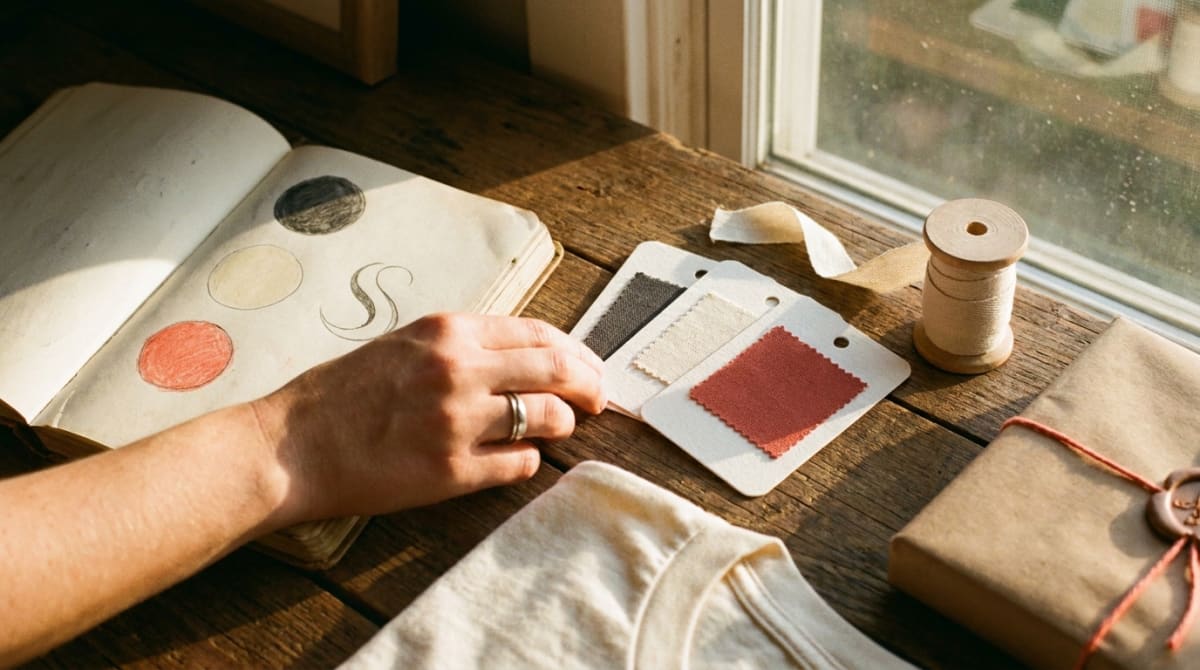
A brand's strength does not come from one beautiful element, but from repeating it everywhere. A customer meets your brand at many points: an ad, then a store, then a confirmation message, then a parcel at their door. When these moments share the same color, tone, and feel, one strong impression forms.
Apply your six elements across every channel. The same colors on the store and social accounts, the same font in designs, and the same tone in descriptions and replies. Packaging is a golden chance for consistency: a parcel carrying your store's identity leaves an impression that outlasts an ad. Draw from custom packaging ideas. And when you photograph your products, keep a steady visual style as in product photography tips.
Building trust and recognition
Consistency leads to two outcomes that drive sales: trust and recognition. Customers buy from those they trust, and they trust what looks organized and coherent. A scattered brand raises doubt even when the product is good.
Standing out in memory comes from repetition and difference together. Choose a visual angle or tone that sets you apart from lookalike stores in your field, then repeat it until it sticks. You do not need to be the loudest, just the clearest and most consistent. Over time, simply seeing your color or your font becomes enough for a customer to remember you before they read your name.
How to build a coherent brand on a small budget
A brand's strength comes from clarity, not spending. A small seller can build a brand that looks professional in a few simple steps.
- Start with a small foundation: a name, a simple logo, two or three colors, one font, and one tone. Do not wait for perfection before launch.
- Document your rules: write your colors, fonts, and tone on a single page you return to. This prevents drift over time.
- Use free tools: free design tools are enough for a logo, a palette, and consistent design templates.
- Apply consistency before expanding: lock your identity across current channels before you add new ones.
- Test before committing: print on demand lets you try your brand's designs and colors on real products without buying inventory upfront.
If your goal is a full clothing brand, build on this foundation with how to start a clothing brand in Saudi Arabia, or start from a youth angle with starting a streetwear brand.
Where Tamm fits in
Building the brand is your call and your taste, but executing it gets easier when everything is under one roof. At Tamm the store and payments are ours, print on demand is in-house and inside Saudi Arabia, and storage and shipping are ours. That means your brand identity shows up consistent from the product page to the printed design to the parcel that reaches the customer, without middlemen breaking the consistency. Read about our print on demand service and our fulfillment, and start free: a store that issues VAT invoices, connects payment gateways, and runs tracking pixels from day one.
The bottom line
A brand for an online store is not the logo, it is the sum of the impression your store leaves in a customer's mind. Build it from six clear elements: the name, the logo, the colors, the fonts, the tone of voice, and the story. Then keep them consistent across storefront, packaging, and social until trust and recognition take hold. You do not need a big budget, just clarity and consistency, free tools, and print on demand to test your identity with no inventory. Start with a simple foundation now, and refine your brand with your first customers instead of waiting for perfection.
Frequently asked questions
- Is a brand just a logo?
- No. The logo is a small part of a brand. Your brand is the sum of the impression your store leaves: the name, colors, fonts, tone of voice, story, and even how you package orders and reply to customers. The logo simply compresses all of that into one mark.
- What core elements do I need to build a brand for my store?
- Six are enough to start: a clear name, a simple logo, a limited color palette, a primary font, a consistent tone of voice, and a story or value that shows why your store exists. Keep them consistent across every touchpoint.
- Why does consistency matter in branding?
- Because repetition builds recognition and trust. When a customer sees the same colors and tone on your store, packaging, and social accounts, they feel they are dealing with one organized business. Fragmentation weakens memory and raises doubt.
- Can I build a strong brand on a small budget?
- Yes. Strength comes from clarity and consistency, not spending. Pick a simple name, two or three colors, one font, and a steady tone, then apply them everywhere. Free design tools and print on demand let you start professionally at low cost.
- When should I start branding, before or after launch?
- Start with a simple foundation before launch: a name, logo, palette, and tone. Do not wait for perfection. A brand matures with your first customers and first feedback, so the priority is to launch with a consistent identity and refine it through experience.