Fashion and streetwear
How to Make a Tech Pack for Your Clothing Brand
A tech pack is the spec document that tells a factory exactly how to make your garment. Here is what it contains and a ready checklist of every section.

A tech pack is the document that tells a factory exactly how to make your garment. It is a page, or a few pages, that gathers everything the production line needs to turn what is in your head into a real piece: the flat sketch, the measurement chart, the materials and bill of materials, the colors, the labels and trims, the construction notes, and the packaging. Without it the factory guesses, and every guess pushes the sample away from your design. That is why no serious factory accepts a manufacturing order without one. If you are a fashion or streetwear founder moving from print on demand to a small production batch, the tech pack is the first thing the line asks you for, and it decides whether your first sample lands close to your vision or far from it.
Why the factory asks for it first
The factory does not know your design, it knows numbers. When you send a photo of a hoodie and say "make it like this," you hand it dozens of decisions: body length, sleeve width, fabric weight, thread type, label placement. A tech pack turns your intent into instructions that leave no room for interpretation. That saves you expensive sample rounds, makes pricing accurate because the factory sees the materials and trims clearly, and protects you when a sample differs from what you agreed. In short, a tech pack moves the conversation from "it felt shorter" to "the spec says 70 cm, the sample is 66."
Flat sketch: the skeleton of the piece
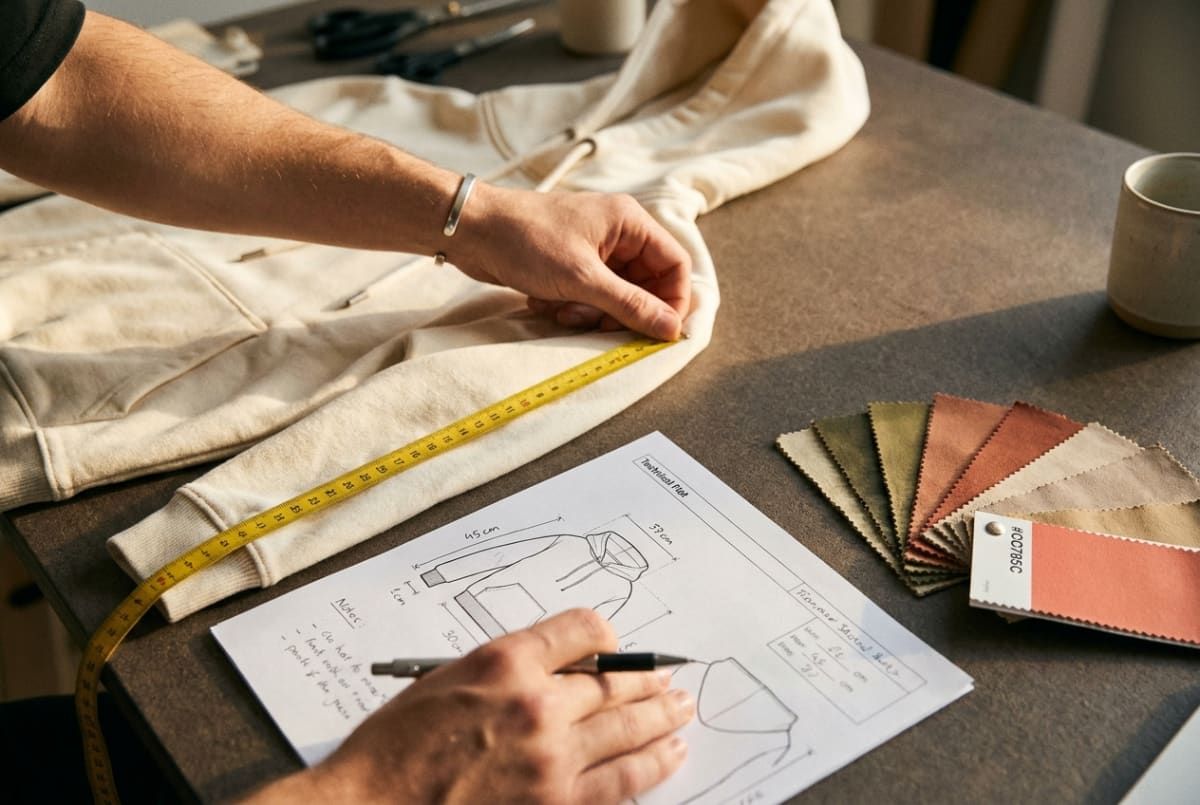
A flat sketch is a technical drawing of the garment as if it were laid flat on a table, front and back, with no body and no shadow. Its job is to show structure: seams, pockets, collar, drawcords, stitch lines. It does not need to be artistic, it needs to be clear and correctly proportioned. Add callout arrows pointing to every detail you will explain later in the construction notes. The flat sketch is the spine that the rest of the document branches from.
Measurements and the graded spec sheet
This is where the numbers live. A points-of-measure chart defines every dimension that matters: chest, body length, shoulder width, neck opening, sleeve length. Then comes grading: how each number changes across sizes from S to XL. Write measurements in centimeters, and define the measurement point precisely, because "sleeve length" can be measured more than one way. Include a tolerance, such as plus or minus 1 cm, so you know when to reject a sample and when to accept it.
Materials and bill of materials (BOM)
The bill of materials lists everything that goes into the piece: the main fabric with its weight and composition, such as 320 gsm cotton, plus every thread, drawcord, zipper, button, and label. For each item write the supplier if you have one, the color, and the quantity per piece. The BOM is what the factory prices you on, so every missing line is a surprise on the invoice later. Make it complete the first time.
Colors: from screen to fabric
The color on your screen is not the color on the fabric. Define every color with a fixed reference, such as a Pantone number or a dyed fabric swatch you send the factory. State the colorways for each piece: the black version, the gray, the cream. Lock the fabric color, the thread color, and the print color separately, since you may want a contrasting thread that shows the seam. A fixed reference ends the "this is not the black I wanted" argument.
Labels, trims, and finishing details
Small details are what separate a brand from a generic piece. The sewn label, the hang tag, the shape of the drawcord tip, the color of the zipper: each one is an identity decision. Specify them in the tech pack clearly, and do not leave them to the factory.
This section gathers everything that is neither fabric nor stitching: the main neck label, the size and care labels, the hang tag, zippers, buttons, drawcord tips, and binding tapes. For each element specify the material, size, color, and exact placement on the piece with a number pointing to the flat sketch. These are the details a customer feels without describing, and they are often what separates a piece that looks "brand" from one that looks generic.
Construction and stitching notes
Here you explain how the piece is assembled. The seam type at each join, the stitches per inch (SPI), where you want a double stitch for durability, how the hem is folded, whether edges are raw or bound. Tie every note to a number on the flat sketch so nothing gets lost in words. The more precise the construction notes, the fewer questions the factory asks and the fewer correction rounds you run.
Packaging
How the piece reaches the customer is part of the product. Specify the fold method, the polybag or carton, the insert card, the sticker, and any internal insert. If you have branded packaging, attach its spec here. This section matters especially if whoever stores and ships for you will repack the item, because a clear spec ensures the parcel goes out the way you want.
Tech pack section checklist (ready to use)
Run through this list before you send the file to any factory:
- Flat sketch: front and back, correctly proportioned, with callout arrows.
- Graded measurement chart: points of measure in centimeters, with a tolerance.
- Materials and bill of materials (BOM): fabric and every thread, cord, and trim.
- Colors: Pantone or swatch reference, and colorways for each piece.
- Labels and trims: neck label, hang tag, zippers, buttons, drawcords.
- Construction notes: seam type, stitches per inch, hem and durability details.
- Packaging: fold, bag, sticker, inserts.
Where Tamm fits in your journey
Before you commit to a factory and a full batch, it helps to test your design in the market first. With print on demand you print a piece only after it sells, so you learn which cut and which color people actually want before you spend on a tech pack and a batch. Then when you move to manufacturing, we handle storage and shipping. If you are early on the path, read what print on demand is.
The bottom line
A tech pack is the technical spec document that turns your design into instructions that leave no room for interpretation: flat sketch, graded measurements, materials and bill of materials, colors with fixed references, labels and trims, construction notes, and packaging. Every field you fill is a decision you do not leave to the factory, and every blank field is a guess that pushes the sample away from your vision. Build a complete tech pack the first time, test your design with print on demand before committing to a batch, and you will enter manufacturing with more confidence and fewer sample rounds.
Frequently asked questions
- What is a tech pack, simply put?
- A tech pack is a technical spec document that tells a factory every detail of your garment: the flat sketch, measurements, materials, colors, labels, and construction. It is the shared language between you and the production line that prevents misunderstanding.
- Do I need a tech pack if I only do print on demand?
- Print on demand needs a design file and a print placement, not a full tech pack. But the moment you move to manufacturing a small batch with your own cut, a tech pack becomes essential because the factory sews the piece from scratch.
- What is the difference between a tech pack and a pattern?
- A tech pack describes the garment in words, numbers, and sketches: measurements, materials, colors, stitching. A pattern is the set of cutting templates the factory uses to cut the fabric. The tech pack directs, the pattern executes.
- Who makes the tech pack?
- A designer, patternmaker, or product developer prepares it. You can start a first version yourself with a measurement chart and a simple sketch, then a factory or specialist reviews it and corrects numbers that cannot be produced.
- What happens if the tech pack is missing information?
- The factory decides for you. Every blank field gets filled with a guess, so the sample comes back different from what you pictured. The rule: leave no field blank, and if you do not know a number, write that you want the factory's suggestion.