Print on demand
The Complete Guide to Selling Custom Beanies
A practical guide to selling custom beanies: styles (cuffed, slouchy, fisherman), materials, embroidery vs woven label vs patch, sizing, quality signals, pricing, and launching with print on demand.

Custom beanies are one of the smartest printed apparel products for cold season because they carry a low cost, a wide margin, and express identity in a single warm piece. To sell them well, start by choosing the style your audience wants (cuffed, slouchy, or fisherman), pick a material (acrylic, wool, or a cotton blend), choose a decoration method (embroidery, woven label, or patch), understand the flexible sizing that keeps stock simple, price on real costs, and launch with print on demand so you never buy stock before you know what sells. This practical guide takes you from style to launch: a clear styles table, a materials guide, decoration methods, numbered launch steps, and an honest pricing base. The core idea is simple: you can build a full beanie brand without tying up a single riyal in inventory that may never move.
Why beanies are a smart product to sell
A beanie combines advantages that rarely meet in one piece. First, it costs less than a hoodie or a jacket yet carries high perceived value, so the margin is comfortable. Second, it is an identity garment worn at the top of the outfit near the face, so it works as a moving billboard for your brand. Third, its flexible single size makes stock far simpler than apparel, since the knit fabric stretches to fit most heads. Fourth, it is a clearly seasonal product that gives you a reason to launch with the first cold, and it is bought alongside a hoodie or jacket as a winter set that lifts the basket. The result is a product with a low cost of entry, healthy profit, easy inventory, and clear identity. That combination serves any seller building a streetwear brand.
Beanie styles: a quick table
The style sets a beanie's personality, its audience, and how it sits on the head. Choose one style that serves your brand identity instead of mixing all of them in a first drop.
| Style | Description | Look | Best for |
|---|---|---|---|
| Cuffed | Double folded band, balanced length | Clean classic | Wide audience, daily wear |
| Slouchy | Longer and looser, drapes at the back | Relaxed and modern | Bold, youthful streetwear |
| Fisherman (short) | Cropped with a thin cuff at the hairline | Minimal and sharp | A clean, current look |
| Uncuffed (docker) | Straight knit with no cuff, snug fit | Simple and sporty | Full-surface designs |
Start with one style and one drop. A cuffed beanie in a neutral color with a small woven label is the easiest starting point because it is the most widely accepted across the season, then expand into slouchy and fisherman once a design proves it sells.
Materials: acrylic, wool, and cotton
The material sets a beanie's warmth, feel, cost, and color-fastness. Choose the material for your audience's climate, not for the cheapest option alone.
- Acrylic: The most common in printed beanies. Warm, color-fast, affordable, and holds bold colors clearly, an excellent starting point for a first drop.
- Wool and wool blends: Warmer with a more premium feel, best for hard cold and highland climates, but pricier and often needing gentler washing care.
- Cotton blend: Lighter and softer on the skin with less itch, suited to mild weather and to anyone who prefers a natural feel.
- Fine-knit acrylic: A tighter stitch that gives a sleeker, less bulky look, suiting the fisherman and a clean outfit.
For Saudi Arabia, the mild winter across most regions makes acrylic and cotton blends a practical choice, while wool serves the highlands and cold nights. Launch beanies with the first cold to catch the peak of seasonal demand.
Decoration methods for a beanie
Stretchy knit fabric calls for different decoration choices than a flat cap. The piece stretches, so the method has to hold up to the pull and stay clean.
- Direct embroidery: The most common method, with the logo embroidered on the front cuff. Durable and premium, it suits logos and lettering, not large graphics or gradients.
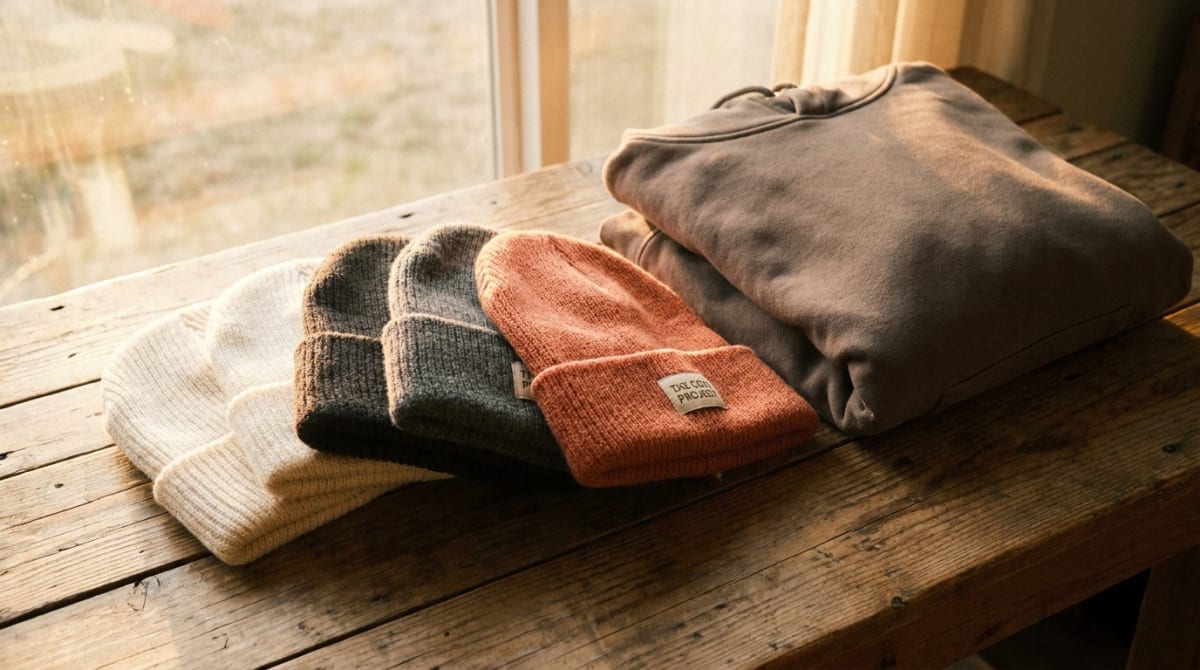
- Woven label: A small woven patch sewn onto the cuff, giving a clean, complete brand look at a reasonable cost, one of the sharpest options on a beanie.
- Embroidered or leather patch: A patch sewn or pressed on for a bigger presence and a bold brand look, common on slouchy beanies.
- Heat transfer print: Possible for multi-color designs but less common, because the stretchy knit may not hold fine detail the way flat fabric does.
For a deeper comparison of fabric print methods, read DTG vs screen printing, and for the basics of building a design that reads clearly, read how to design a t-shirt.
Quality signals you can feel in the hand
A buyer does not read your spec sheet, but they feel quality the moment they put the beanie on. These details separate a brand beanie from a cheap one.
- Knit density. A tight, cohesive stitch you cannot see light through means more warmth and a firmer shape.
- Stretch and recovery. Fabric that stretches then returns to shape without sagging after the first wear is a mark of quality.
- A clean, firm cuff. A cleanly sewn cuff stands firm and does not unfold on the head.
- Embroidery or label finish. Clean stitches with no loose threads and tightly sewn label edges.
- Color-fastness. A color that does not fade after washing, which is what sets apart good acrylic and treated wool.
Beanie design tips
The decoration space on the cuff is small and stretched, so a design that works on a tee can fail here. Simplify your logo into a clear shape that reads from a distance, and make the contrast strong between thread color and beanie color. For embroidery, prepare a clean vector file with strokes thick enough for the needle, and avoid very fine detail because it disappears in the stitches and the knit. The ideal placement is the center of the front cuff, and the logo height is limited by the cuff's width, so do not design taller than it. Pick at least two beanie colors: a neutral that sells to everyone and a bold one that expresses the brand. If you are building a full streetwear label, read how to start a streetwear brand to tie the beanie to the rest of your pieces like the custom hoodie and the cap and your story.
Five steps to launch your beanie with print on demand
- Choose the style and material. Pick one style from the table and a material that suits your audience's climate, and start with one flexible size to keep stock simple.
- Order a sample. Try the beanie in your hand before committing to confirm the warmth, the stretch, and the embroidery or label quality, because what you see on screen is not what you feel.
- Match the design to the decoration method. A logo and lettering lean toward embroidery or a woven label, while a bigger presence leans toward a patch. Design knowing what will be produced.
- Price on real costs. Add the decorated item cost, packaging, shipping, payment fees, and marketing's share, then add a margin.
- Launch with no inventory. Publish the beanie for sale with the first cold, and each piece is decorated after the customer orders and pays, so you test several designs and keep the winner with no loss.
How to price a beanie for profit
Price is not a guess. Add every cost that touches the piece: the decorated beanie, packaging, shipping, payment gateway fees, and each sale's share of your marketing budget. Then add a margin that lets you grow, not just break even. The advantage of print on demand is that your item cost is known in advance, so you calculate your margin precisely before you sell a thing. Do not price cheap to compete, because a beanie is bought for warmth, identity, and feel, not for the lowest price. And since a beanie costs less than a hoodie, its relative margin is often wider, which makes it a smart gateway for building a profitable brand. For more high-margin products that pair with a beanie, see the best print on demand products.
Conclusion
Custom beanies are a smart product to sell because they have a low cost of entry, healthy profit, easy inventory, a clear season, and work as a moving billboard for your brand. To sell them well, choose one style that serves your audience, a material that suits its climate, match your design to a decoration method that survives the knit, read the quality signals a customer can feel, price on real costs rather than a guess, and launch with print on demand so you test your designs with no inventory and no risk. Start small with one sample and one style at the first cold, and let the market tell you which design deserves to scale. For the next step, start free with Tamm, and leave the storage and shipping to us while you focus on the brand.
Frequently asked questions
- What is the difference between a cuffed, slouchy, and fisherman beanie?
- A cuffed beanie has a double folded band and is the balanced classic. A slouchy beanie is longer and looser and drapes at the back for a relaxed look. A fisherman (short) beanie is cropped with a thin cuff that sits at the hairline for a clean, modern look.
- Which material is best for a beanie: acrylic, wool, or cotton?
- Acrylic is the most common because it is warm, color-fast, affordable, and holds bold colors well. Wool or a wool blend is warmer and more premium for very cold weather. A cotton blend is lighter and softer on the skin and better for mild weather.
- How do I decorate a beanie with my logo?
- The most common method is direct embroidery on the cuff, followed by a woven label sewn onto the cuff for a clean brand look, then a sewn or pressed patch. Heat transfer print is possible but less common on stretchy knit fabric.
- Is a beanie one size fits all?
- Most beanie styles are one size because the knit fabric stretches to fit most heads. Some brands offer adult and youth sizes, but one flexible size greatly simplifies your inventory.
- Should I print a batch of beanies before I sell?
- No. Start with print on demand, so each piece is embroidered or decorated after the customer orders and pays. That way you test your designs and colors with no inventory and no risk before any bulk order.