Print on demand
The Complete Guide to Custom Sweatshirts: Weights, Fleece, Print
A practical guide to designing and selling custom crewneck sweatshirts: GSM weights, fleece types, fits, print methods, quality checks, and launching with print on demand.

Custom sweatshirts, the crewneck piece with no hood, are one of the smartest printed apparel products to sell: perceived value beats a tee, the look is cleaner than a hoodie, and it works as a classic year-round layer. To sell them well, start by choosing a blank and a fabric weight (GSM) that fits your audience, pick a fleece type (lighter French terry or warmer brushed fleece), choose a fit (regular, oversized, or boxy), match a print method to the fabric, run quality checks before launch, and launch with print on demand so you never buy stock before you know what sells. This practical guide takes you from blank to launch in clear tables and numbered steps, so you can build a full sweatshirt brand without tying up a single riyal in inventory that may never move.
Why a sweatshirt is a smart product
The sweatshirt sits in a golden zone between the tee and the hoodie. It is more elevated and warmer than a tee, so it justifies a higher price and a wider margin, and it is cleaner and lighter than a hoodie, so it suits a classic look and layering. The absence of a hood, drawstring, and pocket gives it a wide, flat front, which is a dream for any chest design. Men and women wear it equally, and it fits premium brands as well as streetwear. Add year-round air conditioning in Saudi Arabia and the sweatshirt becomes a practical garment inside offices and cafes, not just in winter. The result is a versatile product with a respectable margin and a clean print surface that is hard to ignore.
Blank weights: a GSM table
Weight is measured in grams per square meter (GSM), and it is the first thing that separates your sweatshirt from a cheap one. Heavier holds shape better after washing and feels more premium, but it raises your cost, your price, and your shipping fee. Pick the weight that balances your audience's feel, your price, and your customer's climate.
| Weight class | GSM | Feel | Best for |
|---|---|---|---|
| Light | 220 to 260 | Light, breathable | Warm climate, inner layer |
| Mid | 260 to 320 | Balanced daily | Best seller, general brand |
| Heavy | 320 to 360 | Dense, premium | Elevated streetwear |
| Ultra heavy | 360 to 400+ | Solid, substantial | Limited premium drops |
Order a sample in two weights before you commit. The difference between 260 and 360 GSM is felt in the hand instantly, and it is often the difference between a sweatshirt that looks homemade and one that reads like a real brand.
Fleece types: French terry and brushed fleece
The inner knit decides how warm and soft the piece feels as much as the weight does. Choose the type that suits your customer's climate and use.
- French terry: Unbrushed cotton loops inside, light and breathable, and it does not trap heat. Best for the Saudi climate, year-round wear, and air-conditioned spaces.
- Brushed fleece: Soft and fuzzy inside and warmer, with the classic cozy feel. Better as an outer layer and for cold air conditioning or cool evenings.
- Cotton-polyester blend: Resists shrinking and wrinkling and holds its shape longer, a practical choice for brands that want stability after repeated washing.
Lightweight French terry is often the smartest choice for a first drop in the local market, because it stays comfortable in air-conditioned spaces and does not feel heavy to buyers in the hot months.
Fits: regular, oversized, and boxy
Fit changes a sweatshirt's personality more than weight does. Regular sits close to the body with a balanced length, safe and flattering on most bodies and classic brands. Oversized is wider and slightly longer with dropped shoulders, the look streetwear wants because it feels relaxed and current. Boxy is shorter and wider with a clear shoulder angle, bold and youthful and made for limited drops. Choose one fit that serves your brand identity instead of mixing all three. If you are building a streetwear label from scratch, read how to start a streetwear brand, and if you want the full formal path from registration to factory, see how to start a clothing brand in Saudi Arabia.
Print methods for sweatshirts
The sweatshirt's front is clean and flat, an advantage that opens wider print options than a hoodie. Choose the method based on the design, the quantity, and the fabric.
| Method | Best for | Note |
|---|---|---|
| Direct DTG | Colorful designs on cotton, small runs | Ideal for testing several designs with no minimum |
| DTF heat transfer | Sharp colors on cotton and blends | Handles large chest and back placements |
| Screen printing | Large bulk runs in one or two colors | Economical for volume, not for testing designs |
| Embroidery | Small logos and brand name | Premium finish, higher cost, for detail not large art |
DTG works beautifully on high-cotton fabric and suits anyone starting by testing multiple designs. For a deeper comparison of the two most common methods, read DTG vs screen printing, and to understand the production model itself, see what is print on demand.
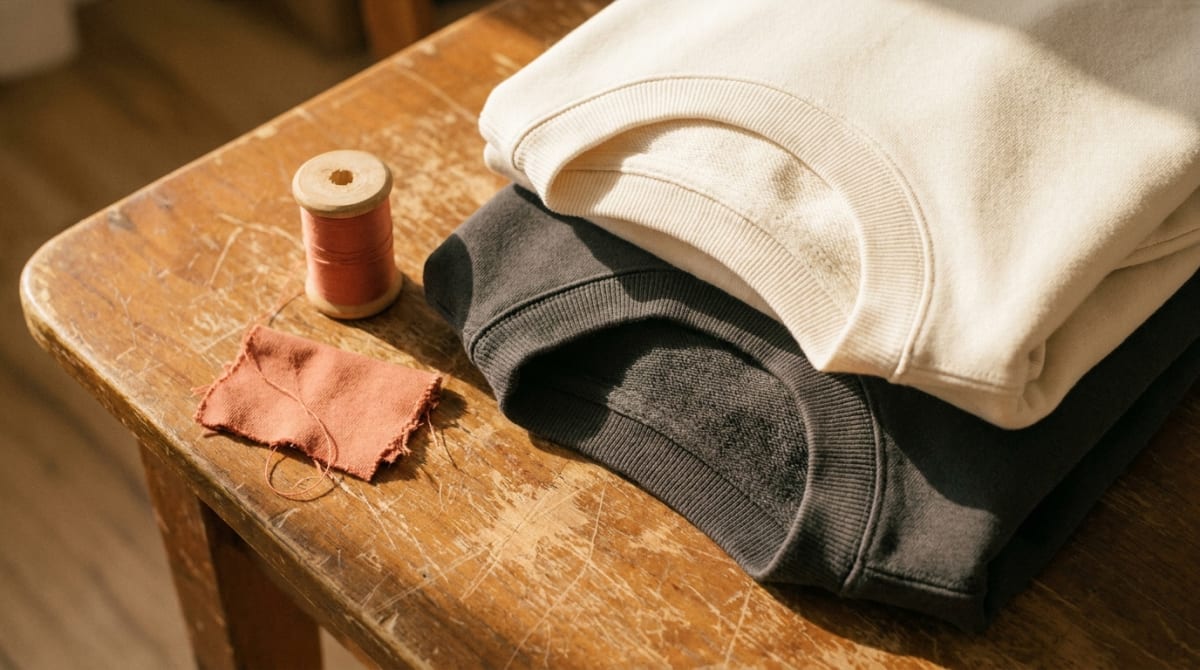
Six steps to launch your sweatshirt with print on demand
- Choose the blank, weight, fleece type, and fit. Pick a GSM, a fleece type, and a fit that serve your audience from the tables above, and order a sample before committing to confirm the feel and sizing.
- Design for the clean front. Use the wide chest area, and prepare a file at 300 DPI with a transparent background. For the basics, see how to design a t-shirt that sells, since the same rules apply.
- Match the design to the print method. A small-run colorful design leans toward DTG, a large sharp graphic leans toward DTF, and a premium logo leans toward embroidery.
- Run quality checks on the sample. Wash the sample, and check print and color durability, sizing accuracy, even stitching at the neck and cuffs, and shrinkage after washing.
- Price on real costs. Add the printed item cost, packaging, shipping, payment gateway fees, and marketing's share, then add a margin that funds growth.
- Launch with no inventory. Publish the sweatshirt for sale, and each piece is printed after the customer orders and pays, so you test several designs and keep the winner with no loss.
Quality checks before launch
Product quality protects your brand more than any ad. Before you launch, run the sample through a quick checklist. Wash it once or twice and check shrinkage, since untreated cotton can shrink. Rub the print with your palm after washing to confirm it does not crack or fade. Inspect the stitching at the crew neckline, the cuffs, and the hem, because even ribbed stitching is a sign of good fabric. Measure the piece against a fixed size chart so every unit ships to the same size. Finally, feel the inside, because a soft, dense fleece matters more than the weight number alone. These ten minutes save you hundreds of return requests.
How to price a sweatshirt for profit
Price is not a guess. Add every cost that touches the piece: the printed sweatshirt, packaging, shipping, payment gateway fees, and each sale's share of your marketing budget. Then add a margin that lets you grow, not just break even. The advantage of print on demand is that your item cost is known in advance, so you calculate your margin precisely before you sell a thing. Do not price cheap to compete, because a sweatshirt audience pays for feel, story, and a clean cut, not for the lowest price. The value you built into the blank, the design, and the quality is what justifies your number.
Conclusion
Custom sweatshirts are a winning product because they sit between the tee and the hoodie in value and look, and they offer a clean print surface with a respectable margin. To sell them well, choose a fabric weight (GSM), a fleece type, and a fit that serve your audience, match your design to a suitable print method, run quality checks on the sample before any launch, price on real costs rather than a guess, and launch with print on demand so you test your designs with no inventory and no risk. Start small with one sample and one weight, and let the market tell you which design deserves to scale. If you want a comparison with the sister piece, see the custom hoodies guide, and for the next step, start free with Tamm and leave the storage and shipping to us while you focus on the brand.
Frequently asked questions
- What is the difference between a sweatshirt and a hoodie?
- A sweatshirt has a crew neckline with no hood and usually no front pocket, while a hoodie has a hood, a drawstring, and often a kangaroo pocket. A sweatshirt is lighter, cleaner-looking, and better for layering and a classic look.
- What fabric weight is best for a sweatshirt?
- Weight is measured in grams per square meter (GSM). Light is around 250 GSM, mid weight is 280 to 320, and premium heavy is 340 to 400. Heavier feels more premium but costs more to make and ship.
- What is the difference between French terry and brushed fleece?
- French terry has unbrushed cotton loops inside, so it is light and breathable and suits a warm climate year-round. Brushed fleece is soft and fuzzy inside and warmer, better as an outer layer and for cold air conditioning.
- What is the best print method for sweatshirts?
- Direct DTG is excellent on cotton and ideal for testing several designs in small quantities, screen printing is economical for bulk, DTF heat transfer gives sharp colors, and embroidery suits premium logos.
- Should I print a batch before I sell?
- No. Start with print on demand, so each piece is printed after the customer orders and pays. That way you test your designs with no inventory and no risk before any bulk order.