Print on demand
The Custom T-Shirt Guide: Fabrics, Fits, Print Methods, and Launch
A practical guide to custom t-shirts: cotton types and GSM weights, fits, necklines, print methods (DTG, DTF, screen), quality signals, and launching a tee line with print on demand.

The custom t-shirt is the cornerstone of any printed apparel brand, because it is cheap to make, easy to print, and worn by everyone. To sell it well, start by choosing a cotton blank and a fabric weight (GSM) that fits your audience, pick a fit and neckline, match a print method to your design and quantity (DTG, DTF, or screen printing), check the quality signals in the blank, and launch with print on demand so you never buy stock before you know what sells. This guide focuses on the product itself rather than the design: fabrics and weights in a clear table, the differences between print methods, how to choose a blank, and numbered launch steps. The core idea is simple: you can build a full tee line without tying up a single riyal in inventory that may never move.
Why the t-shirt is the best product to start with
The t-shirt is the smartest launch point for any apparel seller. It costs less than a hoodie or sweatshirt, so its price reaches a wider audience and the risk of testing a new design is smaller. Its flat surface across the chest and back accepts almost every print method, so design freedom is greater. And it is worn year-round in our climate, alone or as a base layer. Add that it is the most searched printed product, and buyers know it and buy it without hesitation. The result is a low-barrier, high-demand, print-flexible product, the ideal way to test your brand identity before you scale to pricier pieces. For a broader look at which printed products sell best, read the best print on demand products.
Fabrics and weights: a GSM table
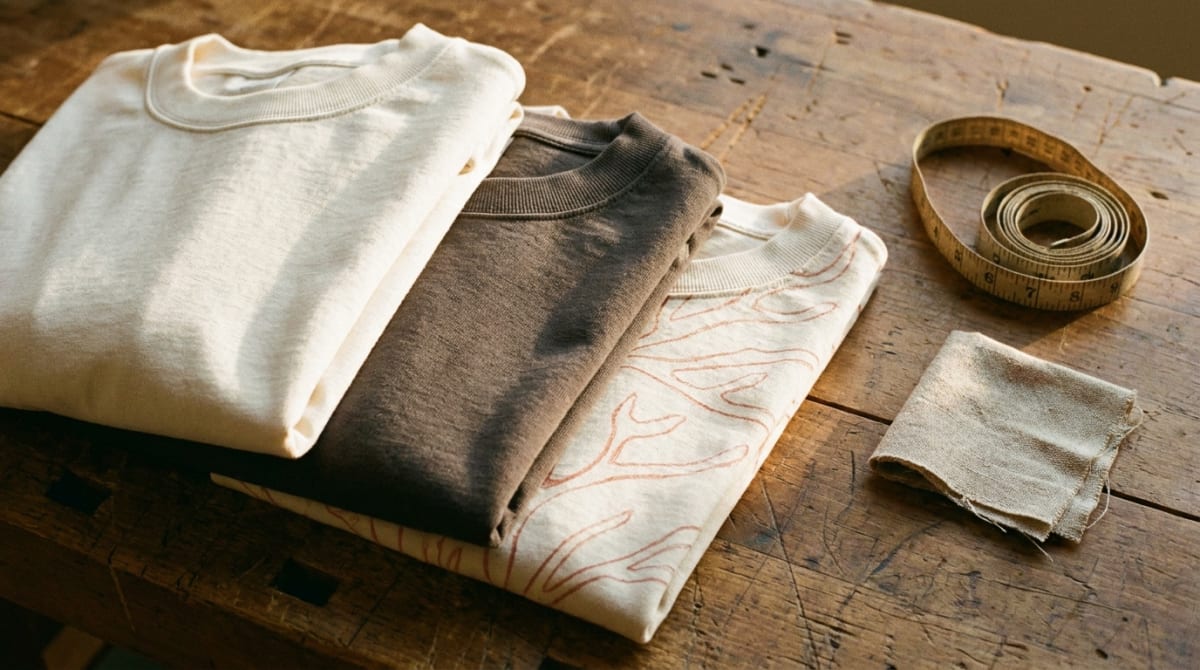
The blank is what separates your tee from a cheap one. Ringspun cotton is spun in a way that removes short fibers, producing a softer, stronger yarn and a smooth surface that holds print detail. Regular carded cotton is cheaper but coarser. A blend (cotton and polyester) resists wrinkles and shrinkage and dries faster. Weight is measured in grams per square meter (GSM), and heavier feels more premium and holds shape better after washing, but it raises your cost and your price.
| Weight class | GSM | Feel | Best for |
|---|---|---|---|
| Light | 130 to 150 | Thin, cool | Hot climate, summer tee |
| Mid | 150 to 180 | Balanced daily | Best seller, general brand |
| Heavy | 180 to 220 | Dense, substantial | Elevated streetwear |
| Ultra heavy | 220 to 240+ | Solid, premium | Limited premium drops |
Order a sample in two weights and two cotton types before you decide. The difference between regular 150 GSM and ringspun 200 GSM is felt in the hand instantly, and it is often the difference between a tee that looks homemade and one that reads like a real brand.
Fits and necklines
Fit and neckline define a t-shirt's personality before any idea is printed on it. Choose what serves your brand identity instead of mixing all three.
- Regular fit: Sits close to the body with a balanced length, safe and flattering on most bodies and audiences.
- Oversized: Wider and slightly longer with dropped shoulders, the look streetwear wants because it feels relaxed and current.
- Boxy: Shorter and wider with a clear shoulder angle, bold and youthful and made for limited drops.
For necklines, two dominate: the crew neck, the default for most brands, and the softer-looking V-neck, better for a dressier look. Make sure the neckline is ribbed and snaps back after stretching, because a collar that sags after a week exposes the blank's quality no matter how good your design is.
Print methods: DTG, DTF, and screen printing
The print method decides your t-shirt's quality, cost, and fit for your quantity. Each method has a place where it wins, and the right choice depends on the design, the quantity, and the fabric.
| Criterion | Direct DTG | DTF heat transfer | Screen printing |
|---|---|---|---|
| Best for | Colorful designs, small runs | Cotton and blends, sharp colors | Large bulk, few colors |
| Number of colors | Practically unlimited | Practically unlimited | Limited by screens |
| Hand feel | Soft, blends into fabric | A layer felt on the fabric | Depends on ink and layers |
| Fabric | Best on cotton | Cotton, blends, polyester | Most fabrics |
| Quantity economics | Fixed per piece | Fixed per piece | Cheaper as volume grows |
The practical takeaway: for print on demand and testing many designs in small runs, DTG wins on cotton and DTF wins on blends and sharp colors, because the per-piece cost is fixed and needs no minimum. Screen printing stays cheapest for large runs in one or two colors, but it is a poor fit for the testing stage. For a deeper comparison, read DTG vs screen printing, and to compare the two digital methods, see DTG vs DTF.
How to choose a blank and check its quality
A good blank is half the product's success. Before you build a full line on a specific tee, feel it in your hand and order a sample.
- Stitching: Look for double stitching at the collar, sleeves, and hem, a sign of durability that survives repeated washing.
- Collar recovery: Stretch the collar gently. A good one snaps back instantly, a poor one sags and stays stretched.
- Weave consistency: Hold the fabric to the light. An even weave with no gaps signals good cotton that takes print reliably.
- Size stability: A good tee does not shrink noticeably after the first wash. Ask about pre-shrink treatment.
Do not rely on a photo or written spec alone. Order a sample actually printed with your design on the blank you will sell, and check the feel and colors after a wash or two before you launch.
Five steps to launch your t-shirt with print on demand
- Choose the blank, weight, and fit. Pick a cotton type, GSM, and fit that serve your audience from the tables above, and order a sample before committing.
- Prepare the design for print. Prepare a file at 300 DPI with a transparent background, and mind the placement on the chest or back. For design basics, see how to design a t-shirt that sells.
- Match the design to the print method. Multi-color art on cotton leans toward DTG, while a blend with sharp colors leans toward DTF. Design knowing what will print.
- Price on real costs. Add the printed item cost, packaging, shipping, payment gateway fees, and marketing's share, then add a margin that funds growth.
- Launch with no inventory. Publish the tee for sale, and each piece is printed after the customer orders and pays, so you test several designs and keep the winner with no loss.
From a t-shirt to a full line
The t-shirt is the entry point, but the audience that loves your design will buy higher-value pieces. Once a design proves itself on the tee, extend it to the higher-margin custom hoodie with the same identity. That is how you build a complete line without risk: test cheaply on the tee, then scale only the winners to pricier pieces. And because print on demand imposes no minimum, you launch every new piece on the same logic: publish, test, scale what sells. To understand the model from the ground up, read what is print on demand.
Conclusion
The custom t-shirt is the best product to start with because it is low-cost, high-demand, and flexible to print. To sell it well, choose a cotton blank and a fabric weight (GSM) that serve your audience, pick a fit and neckline that express your identity, match your design to a print method built for your fabric and quantity, check the quality signals in the blank before building on it, and launch with print on demand so you test your designs with no inventory and no risk. Start small with one sample and one weight, and let the market tell you which design deserves to scale. For the next step, start free with Tamm, and leave the storage and shipping to us while you focus on the brand.
Frequently asked questions
- What cotton is best for a custom t-shirt?
- Ringspun cotton is softer and more durable than regular carded cotton, with a smooth surface that holds print detail. Regular cotton is cheaper but coarser, and a cotton-polyester blend resists wrinkles and shrinkage.
- What fabric weight is best for a t-shirt?
- Weight is measured in grams per square meter (GSM). Light is around 150 GSM for hot climates, mid weight is 150 to 180 and sells best, and heavy is 180 to 240 for a premium brand feel.
- What is the difference between DTG, DTF, and screen printing?
- DTG prints ink directly into cotton and suits colorful designs in small runs, DTF transfers the design with heat and works on cotton and blends with sharp colors, and screen printing is economical for bulk in a limited number of colors.
- Should I print a batch of t-shirts before I sell?
- No. Start with print on demand, so each piece is printed after the customer orders and pays. That way you test your designs with no inventory and no risk before any bulk order.
- How do I know if a blank t-shirt is good quality?
- Check for double stitching at the collar and sleeves, a ribbed collar that snaps back after stretching, an even weave, and stable sizing after washing. Always order a sample before building your line on it.